Triin Pappel: How EstateGuru Is Simplifying Property Investing with EG Grow
In this interview, we speak with Triin Pappel, CCO of EstateGuru, about EG Grow, the platform’s automated investment product designed to deliver monthly income. We explore how it works, who it is built for, the risks investors should understand, and how EstateGuru positions EG Grow within the broader investing landscape.
What is EG Grow and how does it work in simple terms?
EG Grow is an automated investment product that gives investors access to real estate backed loans in the Baltics without having to select individual projects. Instead of manually building a portfolio, an investor deposits funds, starting from €100 and EstateGuru automatically allocates that capital across a diversified pool of eligible loans based on predefined criteria. Sound very similar to a classic Auto Invest feature, right? But we tried to take it a step further in the context of predictability. What separates EG Grow from a classic automatic investment tool:
- Interest is paid once per month on 10th of the month. Very predictable.
- Interest is calculated from the moment funds leave investors’ accounts until the moment the loan is either repaid or written off.
- That means also during the period of a potential enforcement procedure, thereby increasing return and stability. Minimum ticket per investment is 10€, increasing return by minimising cash drag for investors.
- If the borrower is in trouble with their payments, Estateguru has created a contingency fund from where the interest payment will be made, still on the 10th of the month.
The goal of the product is to remove complexity. The investor receives a fixed annual interest rate, displayed at the time of investment, and income is paid out monthly once funds have been allocated into disbursed loans. Reinvestment can be switched on separately if the investor wants to compound over time.
Who is EG Grow really built for, and who should not be using it?

EG Grow is primarily built for investors who value stable and predictable monthly cash flows. It’s especially suitable for people who want exposure to real estate-backed lending but don’t have the time or experience to actively manage a portfolio. At the same time, it’s not designed for highly active investors who want full control over individual loan selection, and a higher risk-return ratio. Those users may prefer the traditional marketplace where they can pick specific projects. EG Grow works best as a “set-and-forget” component within a broader investment strategy.
EG Grow promises predictable monthly income. What does “predictable” actually mean in practice, and what has to happen in the underlying loans for that to fail?
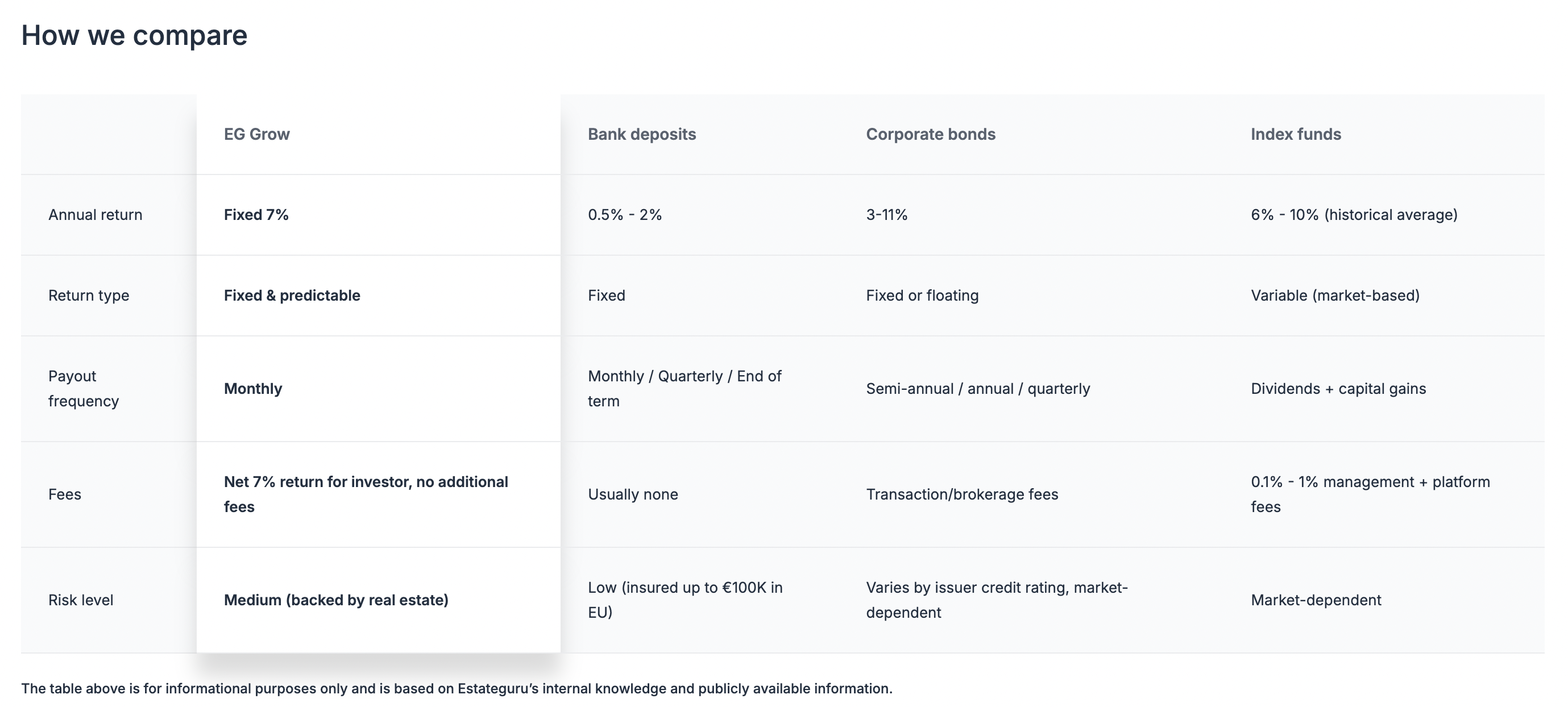
First, I’d clarify the framing: EG Grow is designed to aim for a predictable monthly income. How the EG Grow product is designed to work is that investors receive monthly interest payments at the rate displayed on the platform at the time of investment, currently 7% annually, whether the funds are paid on time by the borrower or, in case of periodic delays, from the contingency fund. However, the fund does not cover principal payments, meaning that in the case of a very rare write-off, the investor still bears investment risk.
One key difference vs similar products is liquidity. What are investors giving up by not having early exit, and in what situations could this become a real problem?
This is an important point to be upfront about. Once funds are allocated into loans through EG Grow, there is no early exit option. Unlike the traditional EstateGuru marketplace, where investors can sell claims on the secondary market, EG Grow investments stay in place until the underlying borrowers repay. Investors can stop adding new funds at any time, but existing positions cannot be liquidated early.
This could become a concern for someone who unexpectedly needs access to their capital, for example, due to a personal financial change or emergency. That’s why we are clear that EG Grow is not designed for short-term liquidity needs. It works best for investors who are comfortable committing capital for the duration of the underlying loan terms, which are typically short to medium in maturity. The trade-off for giving up immediate liquidity is a simpler, more automated investment experience with monthly income.
While manual investments entail the opportunity to use the secondary market for early exit, it is important to keep in mind that a claim sale on the secondary market is only successful once there is a suitable buyer. Therefore, in all cases investors should not invest capital they wish to use elsewhere during the loan period.
What kind of loans does EG Grow invest in, and how should investors think about the risk of losing capital?
EG Grow only invests in loans that meet strict eligibility criteria established within the product’s terms. These are real estate-backed loans originated in the Baltics, secured by first-rank mortgages, with a capped loan-to-value ratio of 69%, 6–18 month maturities, annuity and bullet repayment schedules, and a minimum borrower interest rate of 10%. The criteria are set to ensure that the portfolio maintains a consistent risk profile. Investors don’t pick individual loans, but the rules governing which loans qualify are clearly defined.
On capital risk: investors should understand that capital is at risk. Principal repayment depends on borrower performance and, in problem cases, on the outcome of collateral enforcement and recovery processes. The collateral structure is a meaningful risk-mitigation mechanism, it provides a layer of security, but it does not eliminate the possibility of loss. EstateGuru does not guarantee repayment of principal.
How large is EG Grow today in terms of users and invested volume, and how do you see it evolving over the next 1–2 years?
EG Grow launched in mid-2025, and since then it has become one of the preferred ways new investors start using the platform. We’ve seen a clear shift: a growing share of new users choose EG Grow as their first investment experience on EstateGuru, while existing investors have also adopted it widely. Today, we have more than 3,000 active users in EG Grow, which is in line with our initial expectations.
Over the next one to two years, the focus is on growing the product alongside our loan origination in the Baltics. That means expanding the portfolio of eligible loans, improving the investor experience, and making EG Grow a natural complement to our traditional marketplace. We see EG Grow as both an entry point for newer investors and a retention tool for existing ones who want to keep part of their portfolio on autopilot.
How transparent is EG Grow for investors? What specific data can they see about performance, delays, and the underlying loans, and what is not visible?
Transparency is an important part of the product. Investors can see their portfolio balance, earned income, and overall performance directly within the platform. At the same time, EG Grow abstracts away individual loan-level decision-making, which means users don’t actively select or manage specific projects. However, the eligibility criteria governing which loans qualify for EG Grow portfolios, such as collateral type, LTV limits, and geographic focus, are defined and disclosed. Investors also always have the right to request a specific list of loans in their EG Grow portfolio. The interface we created was intended as a compromise between simplicity and transparency. For those who want deeper insight, the underlying platform still provides access to broader statistics, historical performance, and loan-level data.
Where does EG Grow fit in the investing landscape, and what is the biggest misconception investors have about it today?
EG Grow sits somewhere between traditional savings products and more active investment strategies. It is designed to provide access to asset backed investment opportunities, while providing more predictable cash flows. One of the biggest misconceptions is that “predictable” means risk-free. In reality, it’s still an investment product backed by real assets, with both upside and downside factors. The key is understanding that EG Grow is designed to simplify access to real estate-backed investing, not to remove the fundamental dynamics of investing.